MID routing for subscription and rebill offers: where each trial lands, and where its renewals will bill
On a subscription offer, MID routing picks the merchant account for the first charge, and that pick holds for the life of the customer: every renewal and stored-card upsell bills on the same MID. Konnektive, Sticky.io, Checkout Champ and ElasticFunnels all route the initial order and leave the rebill where it started, so the routing rule you set today decides next month's rebill load on each account.
Before you set a single weight, run each MID through our chargeback ratio calculator to see which accounts already sit near a Visa or Mastercard line and should take fewer new trials. If you are still deciding how many accounts the month needs, the MID capacity planner turns sales, the cap and the dispute ratio into that count.
Why a rebill offer needs a routing plan before it scales
A MID is one merchant account at one acquiring bank, with its own monthly cap, its own reserve and its own dispute count. Continuity and trial offers outgrow a single account faster than one-time sales do, because each month's new customers stack on top of last month's renewals. Sellers open a second and third account because one bank rarely approves that volume, and because a single hold on a lone MID stops every renewal at once. If you are still applying for those accounts, our guide to merchant account providers that accept these offers covers the application side.
Load balancing is the rule that decides which account takes each new order. For a subscription seller it does three jobs:
- Splits trials by weight. You might send 20% of new orders to a fresh account and 80% to a seasoned one, so the newer MID builds history without breaching its cap when the first renewals arrive.
- Skips a full account. When one MID reaches its cap, new orders go to the accounts that still have room.
- Survives an outage. If a gateway goes down, new traffic shifts to the next one instead of failing at checkout.
The renewal is the part routing leaves alone. Konnektive's help center says plainly that its ATRI router "only handles the initial sale and does not route recurring billings." Sticky.io offers a preserve-billing setting so rebills always run on the gateway where the order began, and ElasticFunnels keeps upsells and rebills on the MID that stored the card. Plan your caps on that basis: a MID that took 10,000 trials this month will also carry 10,000 rebill attempts next month, plus the declines and disputes those attempts produce.
Spreading trials also spreads exposure, and nothing more. Each account still reports its own disputes, and rebill offers draw more of them than one-time sales because some buyers forget the trial they agreed to. Watching that is what chargeback management software is for.
NMI MID routing: the gateway layer or the checkout layer
Routing can live in two places, and most sellers searching for "NMI MID routing" are deciding between them without knowing it.
The first is inside the gateway. NMI's payment gateway page says you can "onboard and manage multiple MIDs on a single payment gateway account," and its Transaction Routing feature picks the MID for each charge from the routing directives you have active. NMI matters here because so many acquirers who board continuity accounts pair them with it. One payments practitioner on Hacker News put it simply: for a business that genuinely needs specialist processing, "NMI is the most common gateway." NMI's public page describes Transaction Routing in one line, so ask your ISO which directive types your account actually gets before you count on them.
The second is above the gateway, in the CRM or checkout. There the software holds several gateway connections, picks one for each order, and remembers which one stored the card so the renewal bills there. This layer can tie the rule to the product, the funnel or the order amount, because it knows those things and the gateway does not. For a subscription business that memory is the point of the layer: it owns the billing schedule as well as the first charge.
Gateway routing is enough if every MID you hold sits on NMI and you only need a weighted split. Once your accounts sit on different gateways, or you want rules per offer, the decision moves up to the platforms below.
Four checkouts that route subscriptions
These four route first sales across your accounts and keep the renewals on the account that took them, each for a different kind of business. They are grouped rather than ranked, and the facts come from each vendor's own pages and help docs, following our research method.
Konnektive
- Router
- ATRI, initial sales only
- Rebills
- Not routed, stay on the first gateway
- Cascades
- Soft declines on first sales
- Pricing
- Quoted on a sales call
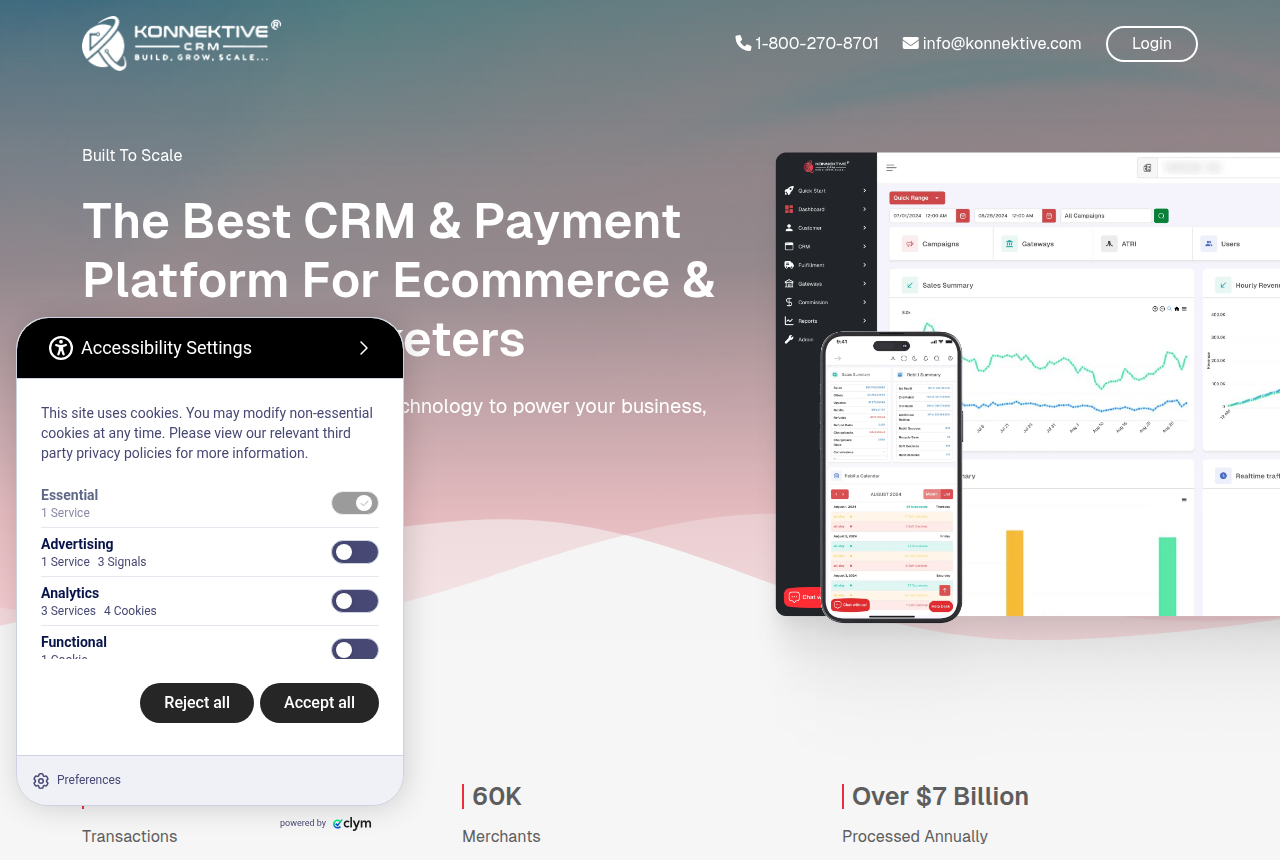
Konnektive is a headless direct-response CRM built around continuity billing: your pages post orders to it, ATRI decides which gateway charges the first sale, and the billing schedule runs from there. It fits sellers whose business already is the subscription and the rebill, and who want routing, cascades and gateway rules managed in one back office. The cost is opacity, since there is no public price and every figure arrives on a call. Our Konnektive review covers the rest of the CRM, and Konnektive vs Sticky.io sets it against its closest rival.

Sticky.io
- Prices read
- 18 Oct 2026
- Base license
- From $499 a month plus 1% of gross sales, falling with volume
- Decline fee
- $0.04 per decline, falling to $0.02
- Routing modes
- Weighted, round robin, priority
- Rebills
- Preserve billing option
Sticky.io is a continuity CRM with a checkout builder, and it builds routing into payment routing profiles. Weighted mode is the default and balances orders against each gateway's current weight, round robin takes turns, and priority follows the order you set. Its help doc also describes failover: if Gateway 1 has an outage, all sales traffic goes to Gateway 2. For a rebill offer, the detail to price in is the per-decline fee on its pricing page, because failed renewals are declines too, and its separate Recovery product retries failed rebills for a share of what it wins back. Caps are set per month, which takes planning if your trial launches come in short spikes. More in our Sticky.io review.
Checkout Champ
- Prices read
- 18 Oct 2026
- Growth
- $300 a month plus 1% of sales
- Gateways
- 270+, including NMI, Authorize.net and Stripe
- Subscriptions
- Billed on any merchant account
- Trial
- None, demo first
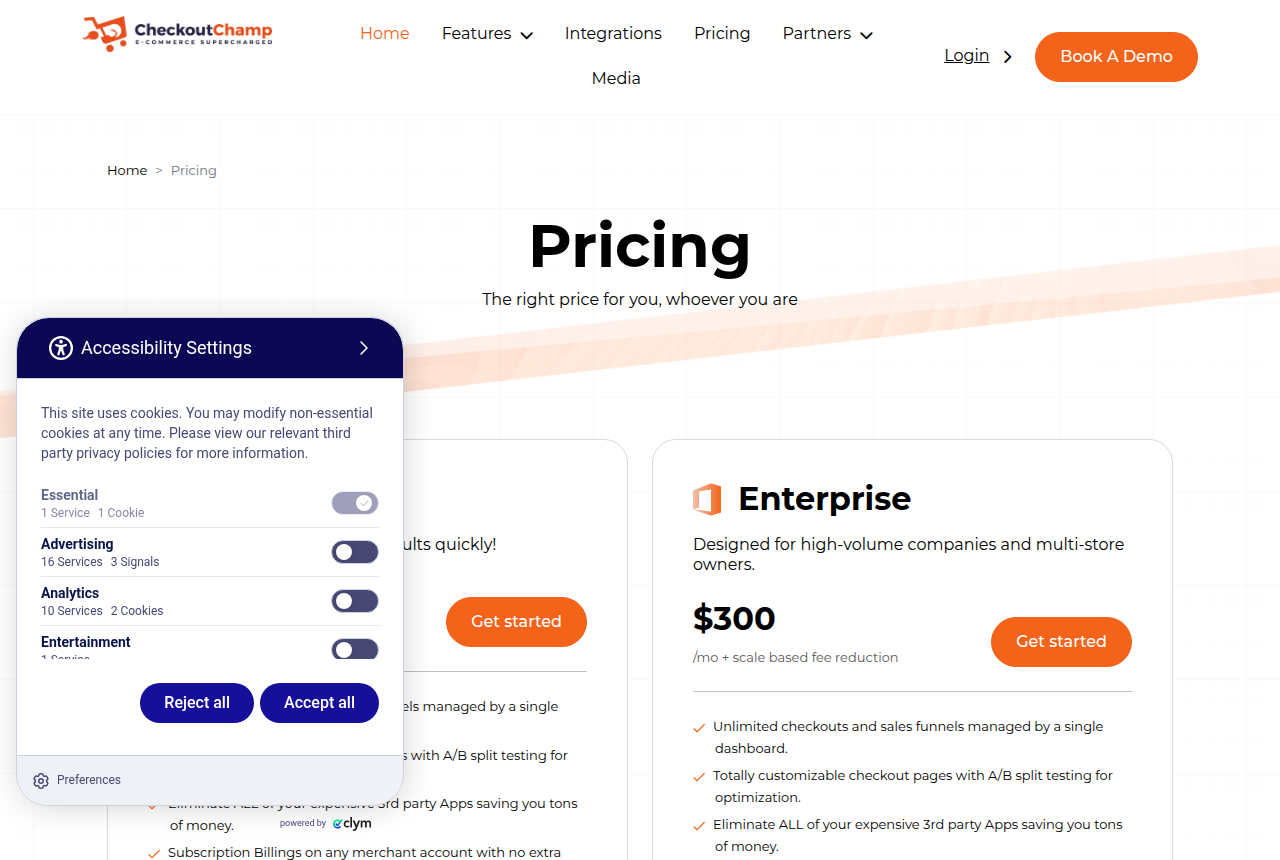
Checkout Champ is a checkout and funnel front end with its own CRM behind it. Its pricing page says subscription billing runs on any merchant account at no extra fee, and it lets subscribers manage their plan and update a card in a customer portal you build, which cuts some of the disputes a forgotten trial produces. It will also migrate an existing subscriber base in. Pick it when you want a hosted checkout with bumps and upsells on a routing back end and would sooner skip building your own pages around a headless CRM. The percentage fee is the objection, because it applies to renewals as well as first sales, and our checkout cost calculator works out what it costs on your revenue. See our Checkout Champ review and Checkout Champ vs Konnektive.
ElasticFunnels
- Prices read
- 18 Oct 2026
- Starter
- $97 a month, every feature included
- Trial
- 14 days, no card
- Routing
- NMI MIDs only
- Caps
- Daily, per MID
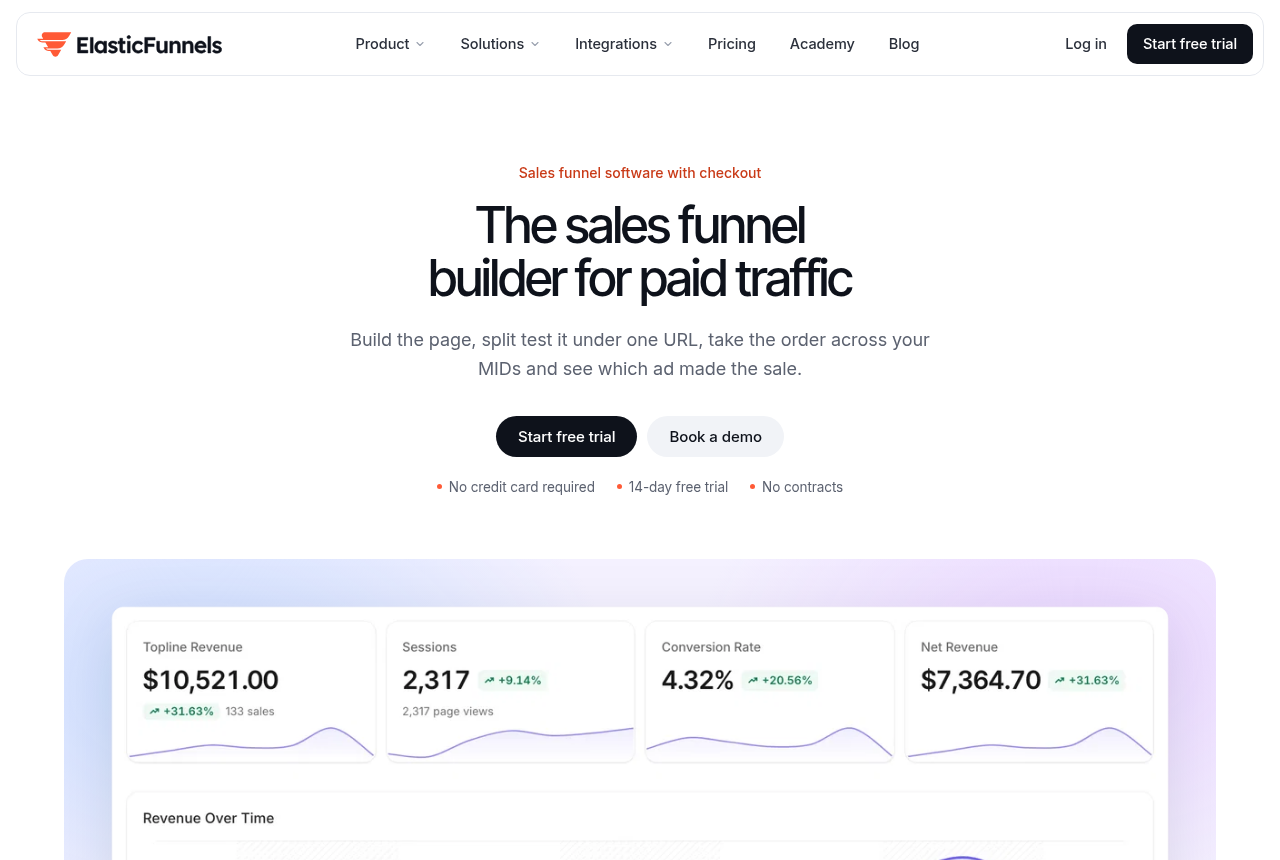
ElasticFunnels is a funnel platform for teams running paid traffic: pages, same-URL split testing, checkout, CRM and attribution on one data layer. Its MID routing splits each first sale by weight across your NMI accounts, filters by card brand, product and amount, skips a MID that has hit its daily cap, and reports sales, revenue and refunds per MID. Upsells and rebills stay on the MID that took the sale. Stripe, PayPal, Klarna and Authorize.net connect as separate payment methods, one account each, and are not part of the routing.
It fits a media buyer selling a subscription offer who wants the landing pages, the same-URL checkout tests and the MID split in one tool, with each trial, rebill and refund on one customer record instead of a page builder posting to a separate CRM. Daily caps also suit trial launch spikes better than a monthly limit does. The drawback is evidence: it is newer than the CRMs above, and there is very little independent review coverage to check its routing against, so until you run real volume through it you are relying on the vendor's word. That is normal for a platform built since 2023, and the 14-day trial lets you test the routing on a small split before moving volume. Our ElasticFunnels review covers the rest of the platform.
Which declines a cascade may retry
A cascade sends a declined first charge to another gateway and tries again. When the issuer's refusal is temporary, the retry can save the trial. Retrying the wrong kind of decline is how accounts end up flagged, and on a rebill offer a flagged account takes its whole subscriber base with it.
Konnektive shows the line clearly. Its cascade profiles reattempt soft-declined initial transactions up to 5 times, and "Hard Declines or Insufficient Funds will not cascade." Sticky.io markets automatic cascading on its homepage, but its help doc on routing profiles only covers outage failover. Ask in the demo which decline codes it retries.
A failed renewal is a different problem. It stays on its own MID, so the fix is a timed retry on that same account, which is what dunning does. ElasticFunnels' routing page makes the general case for first sales too: a stolen card, a closed account or an issuer block should never be retried on another MID, because every retry inflates your decline ratio. Before you switch on any cascade, ask the vendor for its list of excluded decline codes and keep the attempt count low.
What single-processor checkouts cannot do
Most creator checkouts connect one account per processor. Our catalog rows for SamCart, ClickFunnels and ThriveCart list no multi-MID routing, which is fine while one Stripe account carries every subscription. If that describes you today, routing is not your problem yet, and the cost calculator is a better use of the next ten minutes.
My take
I'd pick by what the business already is. If rebills are the business and volume is already real, I'd go with Konnektive or Sticky.io. Sticky.io gives you a published starting price, and Konnektive documents its cascade rules in detail. For a hosted checkout on that kind of back end, with a subscriber portal included, I'd pick Checkout Champ. If your days are spent in ad accounts and you want the pages, the split tests and an NMI split in one place, I'd try ElasticFunnels on a small share of new trials first. Whichever you choose, set the caps for the month the renewals arrive, not the week the trials start, and remember that routing will not replace underwriting: no setting on any of these turns a declined application into a MID.
Your next step
Know which accounts can take more trials before you set a single weight. Check each MID's chargeback ratio against Visa and Mastercard, then give the most new volume to the accounts with the most room under the line.
Frequently asked questions
Can I move existing subscribers to a new MID?
How many merchant accounts does a rebill offer need before routing is worth it?
Does spreading trials across MIDs lower my chargeback ratio?
Written by
Last checked 2026-10-18
Comments
No comments yet. Questions and your own experience are welcome.
Thank you. Your comment will appear once it has been reviewed.