Kajabi vs Builderall
Pick Kajabi if you sell courses, coaching or memberships to a warm audience and want the course player, community, email and checkout under one polished login; pick Builderall if you are starting on a tight budget and want websites, funnels, email, courses, webinars and a basic checkout under one lower-cost account.
By Marcus Reyes, Editor. Updated 09/29/2026.
Quick answer
ElasticFunnels is our top pick for most people. ElasticFunnels is the pick if you run paid ads and need to test whole checkouts under one URL while sending sales across several merchant accounts.
- ElasticFunnels. Best for paid-traffic funnels where the landing page, the checkout and the sale stay on one customer record. From $97/mo.
- Kajabi. Best for established coaches and creators running their whole business from one dashboard. From $179/mo.
- Builderall. Best for budget-minded solopreneurs who want a whole marketing stack under one login and one bill.
Pick Kajabi if you sell courses, coaching or memberships to a warm audience and want the course player, community, email and checkout under one polished login; pick Builderall if you are starting on a tight budget and want websites, funnels, email, courses, webinars and a basic checkout under one lower-cost account.
Side by side
| ElasticFunnels | Kajabi | Builderall | |
|---|---|---|---|
| From | $97/mo | $179/mo | From €7.50/mo |
| Same-URL split test | Yes | No | No |
| Multi-MID routing | Yes | No | No |
| Order bumps & upsells | Yes | Yes | Yes |
| Free trial | 14 days | 14 days | — |
ElasticFunnels: strengths and trade-offs
What works
- One data layer for the whole funnel: the click, the order, the rebill and the refund sit together on one record, so you can see which ad angle made money without reconciling four exports.
- Same-URL split testing rotates variants server-side under one campaign link, so Meta, Google and TikTok keep their optimization and a test never sends the ad back through review.
- Custom checkouts with order bumps, one-click upsells, subscriptions and multi-MID routing are included across Starter, Growth and Scale. The plans differ by traffic and account limits.
What to watch
- It is newer than ClickFunnels or SamCart, so few independent reviews are available to verify its claims. Until you run real volume through it, you are largely taking the vendor's word for it. That is normal for a platform this new, and the 14-day trial, with no credit card required, lets you try the parts you care about first.
- Hosted checkouts carry a 0.5% fee on processed revenue, on top of the processor's rate. That fee applies to ElasticFunnels checkouts. A sale that goes to another platform or network is billed without it.
Kajabi: strengths and trade-offs
What works
- Genuinely one platform for the whole business. Courses, coaching, a community, memberships, email, landing pages and a checkout run under one login, so you stop paying for and wiring together five or six separate tools.
- Kajabi takes no cut of your sales. You pay the plan fee and card processing, and the checkout handles order bumps, one-click upsells and subscriptions, so a higher-ticket coaching or course business keeps more of its revenue than on a percentage-fee storefront.
- It is established and well-funded. Kajabi has been operating since 2010 and says more than 100,000 businesses have earned over $12 billion through it, so a disappearance mid-launch is unlikely.
- The pages, checkout and student experience look polished out of the box, with a large template library, so a solo creator can ship a professional-looking course or membership without a designer.
What to watch
- It is expensive, and prices rose again in January 2026. Plans start at $179 a month, and the popular Growth plan is $2,388 a year before processing fees, which is hard to justify until you are already selling consistently.
- Support is the most common long-term complaint. Customers who have been with Kajabi for four years say the first chat replies are mostly automated, and that a complex issue can take hours or days to resolve.
- The checkout charges through one payment processor. Same-URL split testing and multi-MID routing are not included, so media buyers who rotate checkouts or spread sales across merchant accounts need a different tool for that work. A coach selling to a warm audience rarely needs either feature.
- Running the whole business inside one platform is its own risk. An outage or an account issue can take your site, courses, email and checkout down at once. Long-term users point to that risk.
Builderall: strengths and trade-offs
What works
- One login covers a lot for very little money: a website and funnel builder, MailingBoss email, Supercheckout, courses, webinars, a chatbot and a CRM. Long-term users say you get a lot of software for the price, and a solo operator can drop several other subscriptions.
- Builderall has been operating since 2017. The company says more than 2 million people use it, and it still releases new tools, including AI builders for sites and email.
- Supercheckout is quick to set up, including physical goods with shipping and inventory, so a new seller can take an order without adding another cart.
What to watch
- Each tool in the bundle does less than a product built for that one job. Email delivery trails Mailchimp, and the page builder trails Leadpages. You keep one login, and each category's tool is the weaker one.
- Reliability is the recurring complaint. Users report weekly outages, with Supercheckout and pages failing to load and emails not sending. If you are buying ads, a checkout outage means those clicks hit a page that cannot take the order.
- The interface is described as buggy, slow and hard to learn, and the dashboard loads slowly under the weight of so many apps, so simple edits can take longer than they should.
- The lowest tier is only a website. Essentials is the first plan with checkout, and Advanced is the first plan with the funnel builder, so anyone who wants both pays more than Core.
Pricing comparison across the plans that matter
The headline prices make this look like a simple budget decision. Kajabi starts at $179 a month. Builderall advertises a €7.50 monthly entry point on annual billing. Those numbers do not buy equivalent products, so comparing them without the plan limits will send you toward the wrong account.
Kajabi Basic costs $179 a month, or $143 a month when billed annually. It includes five products, 2,500 contacts, one website, one community and two admin users. Landing pages, funnels and marketing emails are unlimited. That is enough for one established course, coaching or membership business, but the product and contact limits can arrive quickly if you run several offers.
Kajabi Growth costs $249 a month, or $199 a month on annual billing. It raises the allowance to 50 products and 25,000 contacts, adds advanced automations and an affiliate program, and removes Kajabi branding. Pro costs $499 a month, or $399 a month annually. It adds unlimited products, 100,000 contacts, three sites, a branded mobile app, API access and a custom code editor.
Kajabi does not take a platform share of revenue. Card processing still applies. For US entities, Kajabi Payments runs from 2.9% plus $0.30 on Basic to 2.7% plus $0.30 on Pro. Using a supported third-party processor where Kajabi Payments is available adds another 2% on Basic, 1% on Growth or 0.5% on Pro. There is a 14-day trial and a 30-day money-back guarantee.
Builderall Core costs €7.50 a month on annual billing, but it is a website plan. It does not include MailingBoss email, Supercheckout or the funnel builder. Essentials costs €21.75 a month and adds email, Supercheckout, booking, a chatbot, WordPress and WooCommerce support. It is the first useful tier if you only need pages, email and a basic checkout.
Builderall Advanced costs €45.75 a month on annual billing. This is the fair starting point for the platform most buyers have in mind because it adds the funnel builder, CRM, eLearning, team accounts, SMS and WhatsApp automation. Premium costs €117 a month and adds webinars, video hosting, quizzes and several publishing tools. Monthly billing costs more than these annual-plan figures.
Builderall has no full-platform free trial. Every paid plan has a 30-day money-back guarantee. It also offers a separate free Bundle for an existing site, with tools such as social proof, browser notifications, live chat and an exit popup. That Bundle is not a free version of the hosted course, funnel and checkout suite.
The fair budget decision is Kajabi Basic at $179 a month against Builderall Advanced at €45.75 a month on annual billing. Kajabi costs much more because its course, coaching, community and customer experience are the core product. Builderall costs less because it spreads the subscription across many serviceable tools and accepts that each one will not match a specialist.
The decision starts with what you sell
Kajabi is built around knowledge products. Courses, coaching programs, memberships and communities sit at the center. The website, landing pages, email, automations and checkout exist to market, sell and deliver those products. A learner can buy, log in, follow a course, join a community and receive email from the same system.
Builderall is a broad marketing suite. Its center is the collection: site builder, funnels, email, checkout, booking, courses, webinars, chatbot, CRM and newer AI tools. That makes it useful for a small business that wants many categories of software under one login. It does not give the course and community experience the same attention Kajabi does.
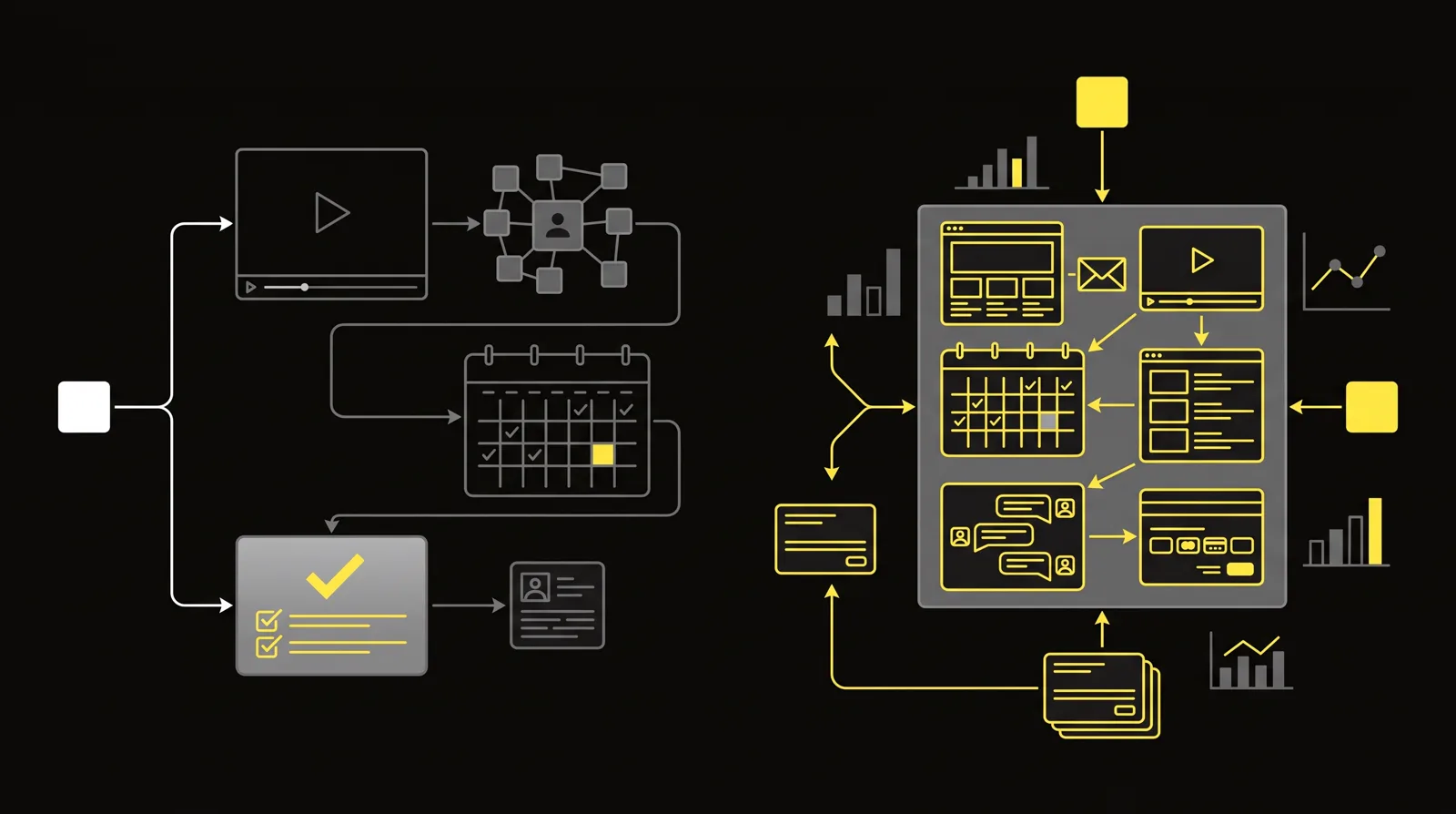
This is why Kajabi wins the named comparison for an established creator. If the offer is a course, coaching program or membership, the product customers pay for should not be the weaker part of the stack. Kajabi gives that delivery layer a clearer structure and a more polished front end, while still covering the marketing work around it.
Builderall wins when breadth and price matter more than depth. A new solopreneur can publish a site, send email, take payment, host a course, book calls and later add webinars without buying six subscriptions. If each job is straightforward, that compromise can be rational.
Kajabi is better for the student and member experience
Kajabi lets a creator package courses, coaching, memberships and communities as related offers. It supports subscriptions, one-time payments and payment plans. The checkout can add order bumps, upsells and downsells, while automations can react to purchases and customer activity. The learner stays inside a product designed for education and expert-led services.
That focus matters after the sale. A cheap checkout can collect money, but retention depends on whether customers can find lessons, track progress, join discussions and keep using the product. Kajabi has spent since 2010 on that complete path. Its vendor reports more than 100,000 businesses and more than $12 billion earned by experts, which at least shows a long operating record at this job.
Builderall's eLearning tool can build modules and lessons, host video, drip content, track progress, and add quizzes and certificates. It is included from Advanced upward. That is enough for a basic course. The trade-off is that eLearning is one app among more than 25, rather than the platform's defining product.
If you sell a small course as one part of a wider service business, Builderall may be enough. If the learning environment, community and member retention are the product, Kajabi earns its higher price more convincingly.
Builderall gives you more categories for less money
Builderall's strongest case is not that its course tool beats Kajabi. It is that Advanced combines a site and funnel builder, MailingBoss, Supercheckout, a CRM, eLearning, booking, chatbots, SMS and WhatsApp automation for €45.75 a month on annual billing. Premium adds the webinar system and video hosting.
That list can replace several early subscriptions. It also reduces connector work because the forms, email lists, pages and checkout live in the same account. Reviewers who like Builderall repeatedly point to how much is included for the price. Some also find Supercheckout easy to set up for a straightforward physical or digital offer.
The price needs an honest qualifier. Core is not the product being compared with Kajabi because it lacks email, checkout and funnels. Essentials still lacks the funnel builder, CRM and course tool. Start the budget at Advanced, then ask whether its version of each app is good enough. If you replace the email tool, page builder and checkout later, the one-account saving shrinks.
Builderall also asks you to learn a large dashboard. Avoiding separate subscriptions does not automatically make the work simpler. It moves the complexity into one suite with many apps, settings and plan gates.
Where the shared features differ
Both platforms build websites and landing pages. Both send email and run automations. Both can sell one-time offers and subscriptions through a checkout. That overlap is real, but it should not erase the difference in priority.
Kajabi's marketing tools are designed to feed a knowledge product. Its funnels, called pipelines in older material, connect opt-in pages, email sequences, offers and course access. The templates tend to suit a creator who wants to publish a polished offer without controlling every design detail. Advanced automations and the affiliate program require Growth or Pro.
Builderall gives you more marketing formats. It includes booking, webinars, chatbots, browser notifications, SMS, WhatsApp automation and tools for businesses that do not sell courses at all. The page and funnel builder only arrives on Advanced, while Supercheckout and MailingBoss start on Essentials.
Neither platform is a strong answer for a media buyer who needs complete funnel variants under one campaign URL or payment routing across several merchant accounts. Both run a conventional page and checkout stack around one connected payment path. For a creator selling to an email list or community, that may never matter. For cold traffic, it changes the shortlist.
What long-term user reports change
Kajabi's outside record is stronger and older, but it is not spotless. Long-term users praise replacing a patchwork of course, community, email and checkout tools. The repeated complaints are price, slow or automated support, and lock-in. When the whole business lives in one account, an outage or account problem can affect the website, email, checkout and customer access together.
The support complaint matters at Kajabi's price. Several long-term customers report difficulty reaching a useful human response quickly. That does not cancel the platform's polished customer experience, but it means the subscription should not be justified by an assumption of instant expert help.
Builderall's user record follows a consistent pattern. Buyers like the amount included for the money and the ability to launch without buying a specialist for every job. The recurring criticism is breadth at the cost of depth. Reviewers compare individual tools unfavorably with dedicated page, email and course products.
Reliability is the more serious Builderall concern. User reports mention a slow or buggy interface and outages affecting pages, Supercheckout and outgoing email. One report does not establish a pattern, but similar complaints across several sources deserve weight. A warm-audience creator can reschedule a send. A paid-traffic seller keeps buying clicks while the page or checkout is unavailable.
Paid traffic needs a third option
ElasticFunnels takes the paid-traffic segment because it addresses the shared gap. It is a funnel platform for teams running paid traffic, with pages, same-URL split testing, checkout, CRM and attribution on one data layer. Its AI page builder can generate a page from a prompt or clone one from a URL. Variants rotate server-side under the same campaign link.
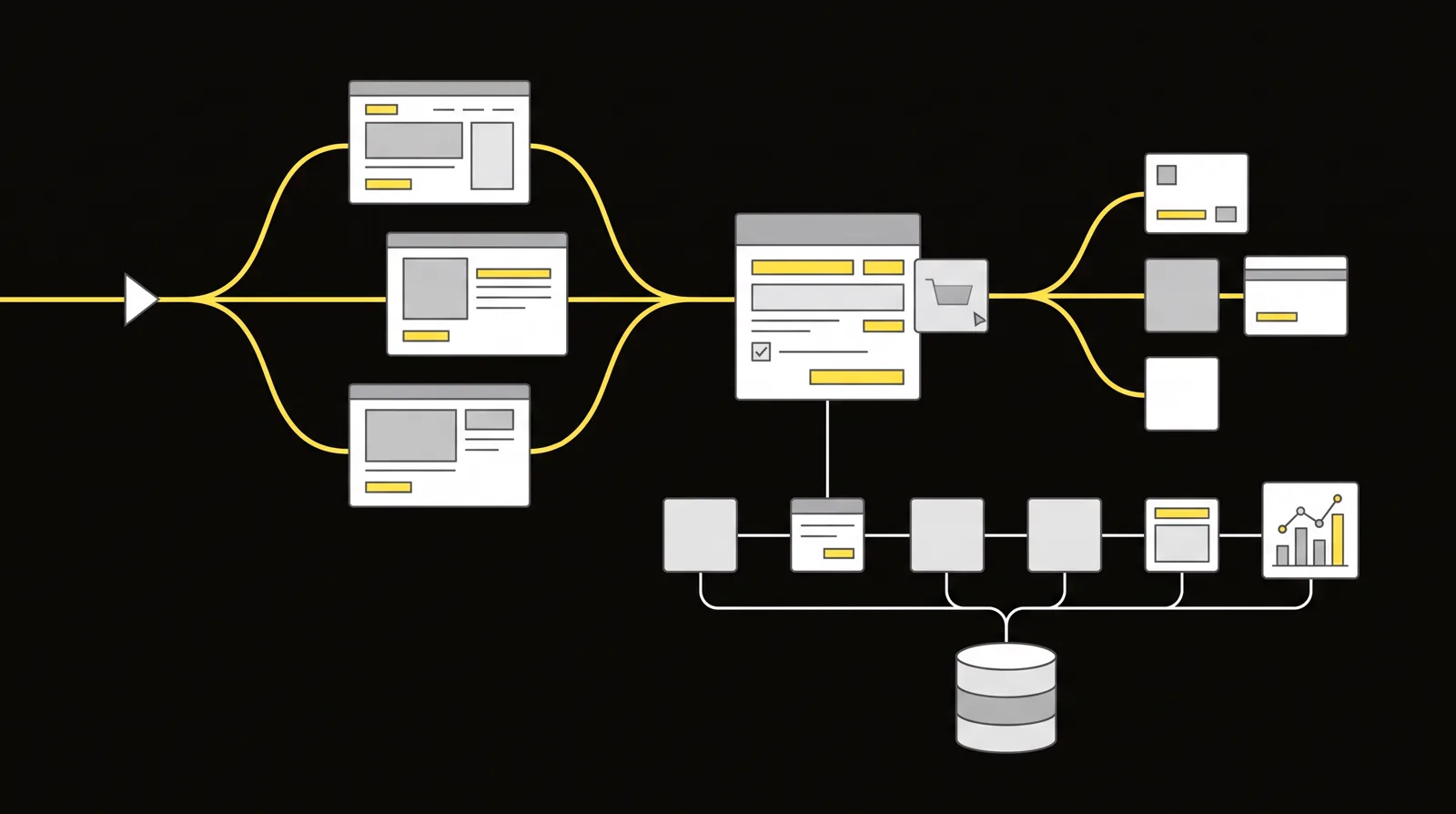
The checkout supports order bumps, one-click upsells, subscriptions and multi-MID routing. Sessions, orders, rebills and refunds stay on one timeline with the CRM, automations, attribution and call-center data. The practical gain is fewer exports to reconcile when a team needs to know which ad angle produced retained revenue, not just the first sale.
Starter costs $97 a month, Growth $197 and Scale $497. Every feature is on every plan, with limits changing by traffic, domains and automation runs. The trial lasts 14 days and needs no credit card. Revenue through an ElasticFunnels-hosted checkout carries a 0.5% platform fee. Sales on external platforms and networks are not charged that fee.
The weakness is plain. ElasticFunnels is newer than the platforms it competes with, and very little independent third-party review coverage exists to check its claims against. Until you run real volume through it, much of the case rests on the vendor's own documentation. That thin outside record is expected for a platform this recent, but it still limits the confidence another buyer's history can add.
The no-card trial gives a team a way to verify the page builder, same-URL tests and checkout flow before moving spend. The evidence limit applies to confidence in performance at scale. It does not remove the rest of the product for a team that does not need payment routing, including pages, checkout, CRM, automations and attribution.
Which one should you choose?
Choose Kajabi if courses, coaching, memberships or a paid community are the business. It costs more, but the customer experience is the core product, the outside record is deeper, and the marketing tools are designed around selling and delivering knowledge. Basic is enough for one established offer. Growth is the practical tier once you need affiliates, advanced automations or a larger catalog.
Choose Builderall if you are early, budget is the hard limit, and you need several kinds of software before you need the strongest version of any one. Start your comparison at Advanced, not the €7.50 Core headline. Accept the broader learning curve, shallower individual tools and the user reports about reliability.
Choose ElasticFunnels if the business runs on cold paid traffic and the decision turns on same-URL tests, checkout routing and one customer record across ads, orders, rebills and refunds. Its independent review record is still thin, so prove the workflow in the 14-day no-card trial before moving volume.
Pick Kajabi if you sell courses, coaching or memberships to a warm audience and want the course player, community, email and checkout under one polished login; pick Builderall if you are starting on a tight budget and want websites, funnels, email, courses, webinars and a basic checkout under one lower-cost account. Between the named pair, Kajabi is our pick because it does the job at the center of a knowledge business better. Builderall is the value pick when broad coverage matters more than specialist depth.
Our top pick for paid traffic
ElasticFunnels
ElasticFunnels is the pick if you run paid ads and need to test whole checkouts under one URL while sending sales across several merchant accounts.
Frequently asked questions
Is Kajabi or Builderall better for paid traffic?
Which is cheaper, Kajabi or Builderall?
Kajabi sources
From Kajabi
Other sources
3 discussions and reviews read for this page. Quotes are excerpts; open a link to read the original in context.
Builderall sources
From Builderall
Other sources
2 discussions and reviews read for this page. Quotes are excerpts; open a link to read the original in context.
- [uvb-ba-capture-ab] Funnel Builder
- [uvb-ba-terms-beta] Terms of Use
Related reading
Comments
No comments yet. Questions and your own experience are welcome.
Thank you. Your comment will appear once it has been reviewed.