Skip to content
Menu

Kajabi review

Checkout & funnel software review Best of the category →

Kajabi is a real, established platform that is genuinely good for coaches and course creators who want one login for courses, community, email and checkout. For a paid-traffic seller it is the wrong tool and an expensive one: the checkout runs a single processor with no same-URL split testing or payment routing, and plans start at $179 a month.

By Marcus Reyes, Editor. Updated 27 September 2026.

Quick answer

ElasticFunnels is our top pick for most people. ElasticFunnels is the pick if you run paid ads and need to split-test whole checkouts under one URL and route payments across processors.

  • ElasticFunnels. Best for Paid-traffic teams that need same-URL split testing and multi-MID checkout on one data layer. From $97/mo.
  • SamCart. Best for Creators and digital sellers who want a fast, high-converting standalone checkout. From $79/mo.
  • ClickFunnels. Best for Beginners who want templates and fast, simple funnels in one familiar platform. From $97/mo.
  • ThriveCart. Best for Creators who want a high-converting checkout without a recurring subscription. From $495/mo.
  • GoHighLevel. Best for Agencies running many client accounts who need CRM, funnels and white-label in one. From $97/mo.
  • Kartra. Best for coaches and course creators who want one login instead of a stack of tools. From $59/mo.
  • Paddle. Best for software, SaaS and digital-product sellers who want tax and compliance handled.
  • Checkout Champ. Best for high-volume direct-response brands that have outgrown a single processor. From $300/mo.
  • Gumroad. Best for creators selling a first digital product without a monthly fee. Has a free tier.
  • Kajabi. Best for established coaches and creators running their whole business from one dashboard. From $179/mo.

You have probably met Kajabi the way most people do. A coach you follow mentions it, an ad promises it will turn what you know into a business, and the name keeps surfacing in every course-creator group you join. So the fair question is the one this page answers: is Kajabi the real thing, and will you regret paying for it?

The short answer to "is it real" is yes. The company has run since 2010, it is well-funded, and it says more than 100,000 businesses have earned over $12 billion in sales on the platform. Whether you regret buying it depends almost entirely on what you sell and how you find your customers, and that is where an honest review has to slow down.

What Kajabi actually is

It is one platform for running a knowledge business. On a single login you can build and sell online courses, run coaching programs, host a membership site and a community, send marketing emails, publish landing pages and funnels, and take payment through a built-in checkout. The pitch is that it replaces the five or six separate tools a solo creator would otherwise stitch together, and for its target customer that pitch is largely true.

That target customer is a coach, consultant, educator or creator selling their own expertise. If you sell courses, coaching, memberships or digital programs and you want them to live in one polished, branded place, this is built for exactly that job and does it well. Long-term users say the appeal is not any single feature but never having to reach for a third-party app to get something done.

Who it is not for

This site ranks checkout and funnel software for teams that point paid ads at an offer. Kajabi is not built for that reader first, and pretending otherwise is how people end up regretting the bill.

Three gaps matter if you live on paid traffic. The checkout runs a single payment processor, so you cannot spread volume across several merchant accounts, which is what nutra, supplement, subscription and other high-risk sellers need. There is no same-URL split testing, so you cannot rotate whole checkout variants under one campaign link the way an ad platform's optimisation prefers. And the checkout, while capable, is built for courses and coaching rather than cold traffic at scale. If those are your requirements, it will feel limiting no matter how much you pay. For a coach selling to a warm audience from email and social, none of it applies, and the single-processor checkout is perfectly fine. Match the tool to the job.

Its closest peer for the coaching and creator reader is Kartra, which folds the same pieces into one login and leans a little harder on funnels and checkout. If you want the paid-traffic platforms instead, they are the ones ranked in our best checkout and funnel software roundup.

The price is the real decision

Kajabi sits at the expensive end of its category, and it raised prices across every plan in January 2026. Basic now starts at $179 a month, or $143 if you pay for the year up front. The popular Growth plan runs $249 monthly, which works out to $2,388 a year before you have paid a cent in card processing. Pro is $499.

What softens that number is the fee model: the company takes no percentage of your sales. You pay the plan and standard card processing, 2.9% + $0.30 on Basic falling to 2.7% + $0.30 on Pro, and nothing more. For a higher-ticket coaching or course business doing real volume, a flat fee with no revenue share often works out cheaper than a percentage-fee storefront. For someone launching a first product with little revenue, it is a heavy fixed cost, and cheaper course tools will get you to a first sale for a fraction of it. The full breakdown is in our Kajabi pricing guide.

The support caveat

The most consistent long-term complaint is support, and it comes up even from people who otherwise like the platform. One customer of four years described the service as "horrendous", with the only channel a chat that is "mostly AI and useless" and replies arriving hours apart. If you rely on fast human help when a launch breaks at 11pm, factor that in before you commit to an annual plan.

So will you regret it?

You will regret it if you buy it to run paid traffic, if you are validating a first offer with no revenue yet, or if fast support is non-negotiable for you. You will not regret it if you are an established coach or creator with a real audience, you want courses, community, email and checkout in one place, and you would rather pay one predictable fee than assemble and maintain a stack. Start on a monthly plan, run a real checkout, a refund and an email sequence through it during the trial, and you will know whether it fits before the first full bill. If it does not, the paid-traffic platforms in our Kajabi alternatives are the ones to weigh next.
What works

  • Genuinely one platform for the whole business. Courses, coaching, a community, memberships, email, landing pages and a checkout run under one login, so you stop paying for and wiring together five or six separate tools.
  • Kajabi takes no cut of your sales. You pay the plan fee and card processing, and the checkout handles order bumps, one-click upsells and subscriptions, so a higher-ticket coaching or course business keeps more of its revenue than on a percentage-fee storefront.
  • It is established and well-funded. Kajabi has run since 2010 and says more than 100,000 businesses have earned over $12 billion through it, so it is not a platform likely to disappear mid-launch.
  • The pages, checkout and student experience look polished out of the box, with a large template library, so a solo creator can ship a professional-looking course or membership without a designer.

What to watch

  • It is expensive, and prices rose again in January 2026. Plans start at $179 a month, and the popular Growth plan is $2,388 a year before processing fees, which is hard to justify until you are already selling consistently.
  • Support is the most repeated long-term complaint. Even four-year customers describe chat that is mostly AI and replies that take hours or days, so do not count on fast human help when a launch breaks.
  • It is not built for paid-traffic direct response. The checkout runs a single processor, with no same-URL split testing and no multi-MID routing, so media buyers who need to rotate whole checkouts or spread volume across merchant accounts will hit a wall. For a coach selling to a warm audience, none of that applies.
  • Running the whole business inside one platform is its own risk. An outage or an account issue can take your site, courses, email and checkout down at once, and long-term users cite exactly that.
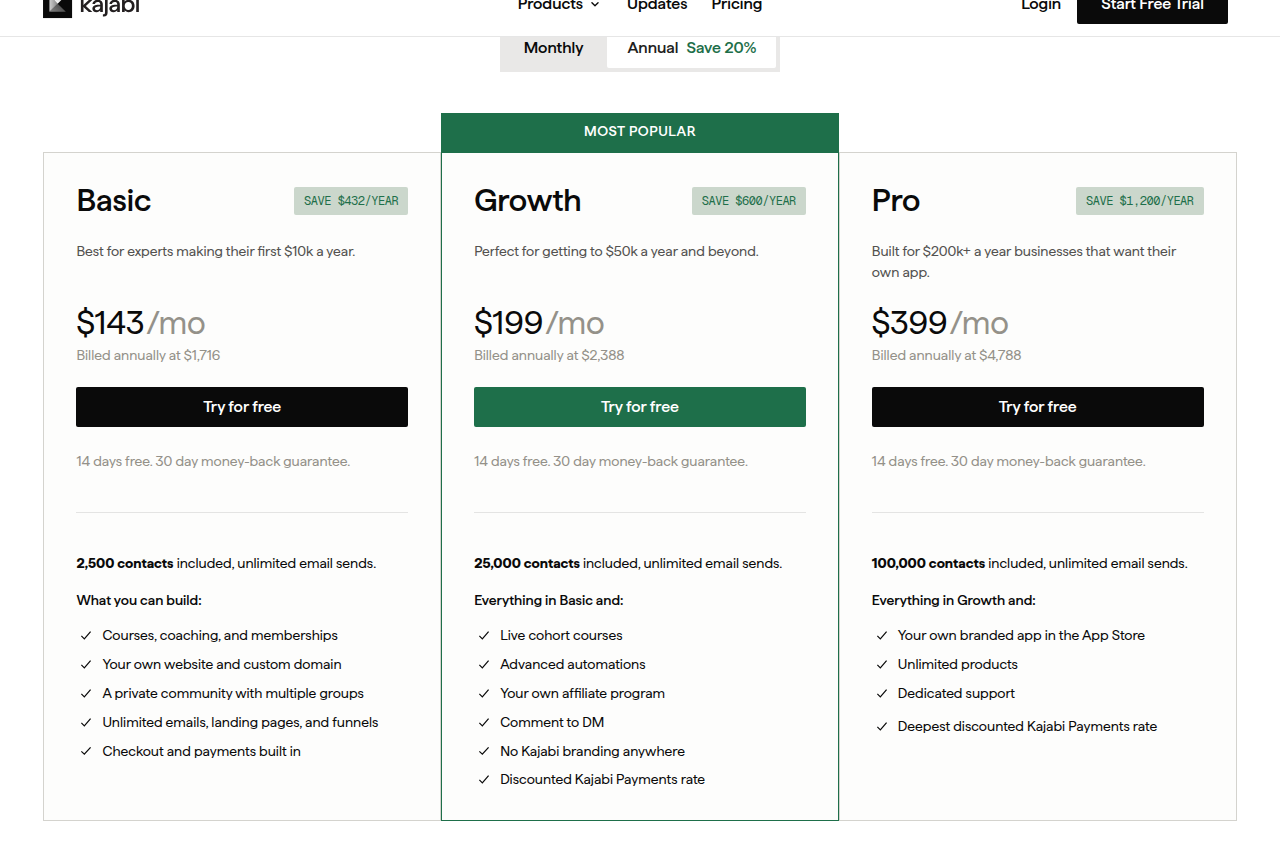
Kajabi's three pricing cards billed annually: Basic $143/mo ($1,716/year), Growth $199/mo ($2,388/year) and Pro $399/mo ($4,788/year), each noting 14 days free and a 30-day money-back guarantee, with feature bullets including courses, community and built-in checkout.
Plan prices. Kajabi's three pricing cards billed annually: Basic $143/mo ($1,716/year), Growth $199/mo ($2,388/year) and Pro $399/mo ($4,788/year), each noting 14 days free and a 30-day money-back guarantee, with feature bullets including courses, community and built-in checkout. Screenshot: kajabi.com,

What buyers keep saying

Research: unverified

The all in one is the real draw ↑ frequently praised

Long-term users like Kajabi because it replaces a stack of separate tools. Coaches and course creators say website, email, CRM, checkout, courses and community run under one login, and that they stop paying for and wiring together five apps.

“Kajabi is great esp for coaches! It has almost everything you need, from website, crm management, email marketing, podcast and more! It's easy to use as well”

Anonymous Reddit: Is anyone here using Kajabi : r/lifecoaching

“And, once you know what you're doing, you really appreciate not having to use third-party apps to get anything done.”

Anonymous Reddit: Confused Between Kajabi and Teachery for My Online Course

Price and platform lock in ↓ common complaint

The loudest recurring complaint is cost. Users cite the Growth plan at $2,388 a year before processing fees, and question whether the feature depth justifies it. The all-in-one model is also its own risk: run the whole business inside Kajabi and an outage or account issue takes everything down at once.

“Kajabi's pretty expensive (we're on the Growth Plan: $2,388 annually) and doesn't seem to be very strong on AI-supported lead magnet dev, AI-supported course dev, email deliverability, and support.”

RSS_ADHD Reddit: Kajabi? : r/onlinecourses

“Always felt it was extremely overpriced for what a feature-limited product it was, not to mention the horror stories I'd see in their FB group of someone's whole business going down because you've got all of your eggs in one basket in Kajabi”

Anonymous Reddit: Kajabi? : r/onlinecourses

Support is the weak spot ↓ common complaint

Even satisfied long-term users single out support as poor: chat that is mostly AI, slow responses measured in hours or days, and little resolution. It is named as a weakness on both coaching and course threads.

“I've been using Kajabi for 4 years for my business. While the platform features are slick and it's an 'all-in-one' site for funnels, campaigns etc, the customer service is horrendous. The only way to speak with someone is via chat, which is mostly AI and useless.”

u/CapitalTasty4399 Reddit: Is anyone here using Kajabi : r/lifecoaching

“Kajabi's pretty expensive (we're on the Growth Plan: $2,388 annually) and doesn't seem to be very strong on AI-supported lead magnet dev, AI-supported course dev, email deliverability, and support.”

RSS_ADHD Reddit: Kajabi? : r/onlinecourses

What Kajabi costs

PlanMonthlyIncludes
Basic$1795 products, 2,500 contacts, 1 website, 1 community, 2 admin users. Unlimited landing pages, funnels and marketing emails. $143/mo on the annual plan.
Growth$24950 products, 25,000 contacts, 1 website, 1 community, 11 admin users, advanced automations, affiliate programs, remove Kajabi branding. $199/mo billed yearly.
Pro$499Unlimited products, 100,000 contacts, 3 websites, 3 communities, 26 admin users, custom code editor, API access, branded mobile app. $399/mo on annual billing.

Three tiers, billed monthly or annually (annual saves 20%): Basic $179/mo ($143/mo on the annual plan), Growth $249/mo ($199/mo annually), Pro $499/mo ($399/mo annually). Kajabi takes no revenue share, but card processing applies: Kajabi Payments is 2.9% + $0.30 on Basic down to 2.7% + $0.30 on Pro (US rates), and using a third-party processor instead adds 2% / 1% / 0.5% by plan. Extra contacts come in blocks of 25,000 for $125/mo. There is a 14-day free trial and a 30-day money-back guarantee. Prices rose across all plans effective January 2026.

Verified against the vendor's pricing page on 2026-09-27.

Frequently asked questions

How much does Kajabi cost?
It starts at $179 per month. See the plans above for what each tier includes.
Does Kajabi offer a free trial?
Yes. Kajabi offers a 14-day free trial, which asks for a card up front.
Is Kajabi built for high-volume paid traffic?
Kajabi connects a single processor by default, so sellers spreading volume across several merchant accounts will find it limiting.

What we read

From Kajabi

Other sources

5 discussions and reviews read for this page. Quotes are excerpts; open a link to read the original in context.

  1. [reddit-lifecoaching-4yr] Is anyone here using Kajabi : r/lifecoaching Reddit
  2. [reddit-lifecoaching-coaches] Is anyone here using Kajabi : r/lifecoaching Reddit
  3. [reddit-onlinecourses-growthcost] Kajabi? : r/onlinecourses Reddit
  4. [reddit-onlinecourses-eggs] Kajabi? : r/onlinecourses Reddit
  5. [reddit-elearning-thirdparty] Confused Between Kajabi and Teachery for My Online Course Reddit

Changelog

  • 27 September 2026 – First published. Pricing and features verified against the vendor's own pages.

Written by

Last checked 2026-09-27