Same-URL vs redirect split testing
Pick same-URL split testing if you run paid traffic on Meta, Google or TikTok and need to change landing pages, presells or checkouts without touching the URL in the ad; pick redirect A/B testing if each variant can live at its own URL, as in email, organic or parallel ad set tests.
By Marcus Reyes, Editor. Updated 10/12/2026.
Quick answer
ElasticFunnels is our top pick for most people. ElasticFunnels is the pick if you run paid ads and need to test whole checkouts under one URL while sending sales across several merchant accounts.
- ElasticFunnels. Best for paid-traffic funnels where the landing page, the checkout and the sale stay on one customer record. From $97/mo.
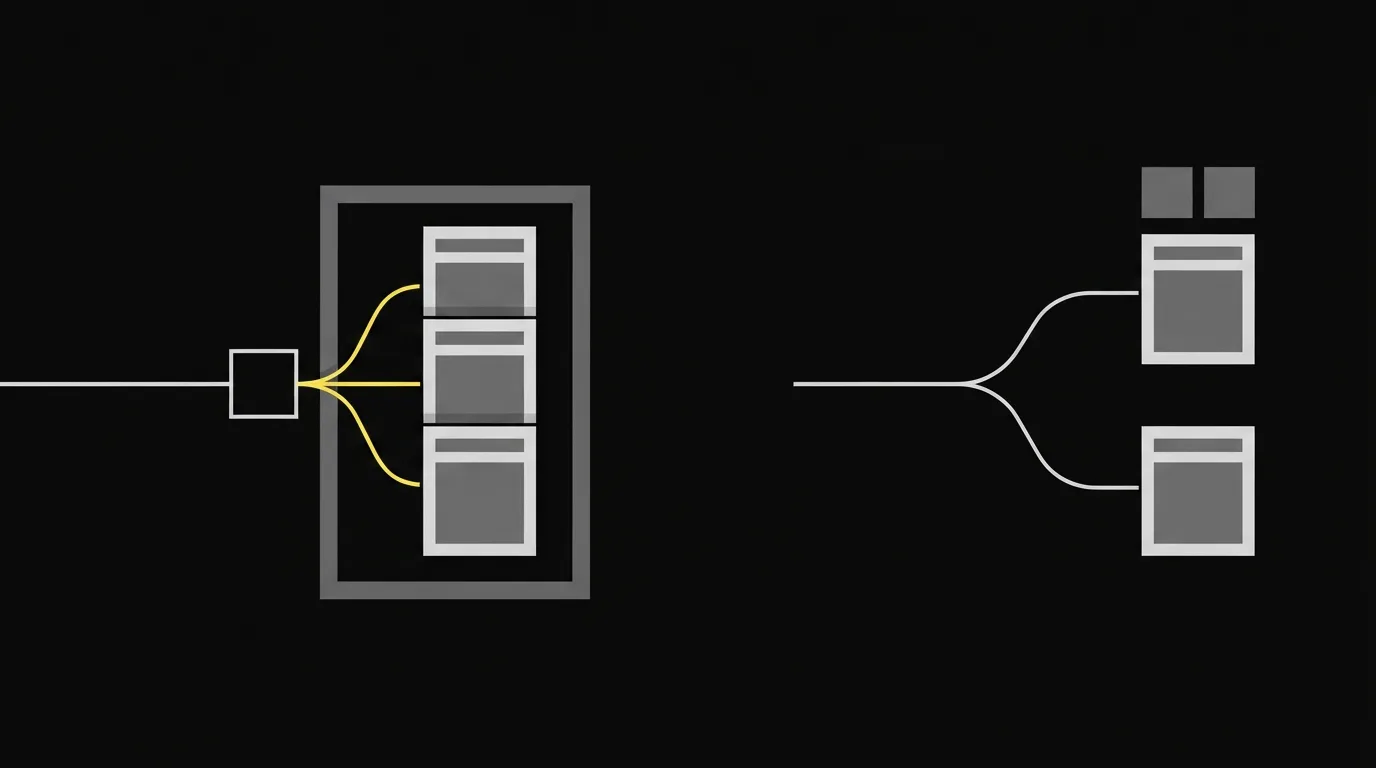
- Same-URL split testing. Best for paid-traffic funnels where the campaign link must stay fixed while pages, presells or checkout paths change.
- Redirect A/B testing. Best for landing page tests where each variant has its own URL, and for email, organic or parallel ad set traffic.
Pick same-URL split testing if you run paid traffic on Meta, Google or TikTok and need to change landing pages, presells or checkouts without touching the URL in the ad; pick redirect A/B testing if each variant can live at its own URL, as in email, organic or parallel ad set tests.
Side by side
| ElasticFunnels | Same-URL split testing | Redirect A/B testing | |
|---|---|---|---|
| From | $97/mo | Bundled into a platform plan | Bundled into page builder plans |
| URL in the ad | One address for the whole test | One address for the whole test | One address per variant |
| Variant chosen | On the server, before the page loads | On the server, before the page loads | By weight, one URL per variant |
| Checkout paths | Yes, with bumps and upsells | Yes, under the same link | Yes, one URL per checkout |
| Winner judged on | Revenue, AOV, EPC, profit, CPA or conversion | Conversion or revenue metrics, by platform | Set by the builder |
| Where you find it | Pages, checkout and CRM together | Funnel platforms that host the page | Landing page and funnel builders |
ElasticFunnels: strengths and trade-offs
What works
- One data layer for the whole funnel: the click, the order, the rebill and the refund sit together on one record, so you can see which ad angle made money without reconciling four exports.
- Same-URL split testing rotates variants server-side under one campaign link, so Meta, Google and TikTok keep their optimization and a test never sends the ad back through review.
- Custom checkouts with order bumps, one-click upsells, subscriptions and multi-MID routing are included across Starter, Growth and Scale. The plans differ by traffic and account limits.
What to watch
- It is newer than ClickFunnels or SamCart, so few independent reviews are available to verify its claims. Until you run real volume through it, you are largely taking the vendor's word for it. That is normal for a platform this new, and the 14-day trial, with no credit card required, lets you try the parts you care about first.
- Hosted checkouts carry a 0.5% fee on processed revenue, on top of the processor's rate. That fee applies to ElasticFunnels checkouts. A sale that goes to another platform or network is billed without it.
Same-URL split testing: strengths and trade-offs
What works
- The ad points at one address for the life of the test, so trying a new angle or checkout path never means editing the destination of a live ad.
- The variant is picked on the server before the page is sent, which avoids both the flicker of a client-side swap and the extra hop of a redirect.
- Platforms built around it can score a test on revenue, AOV, EPC, profit or CPA as well as on conversion rate.
What to watch
- It needs a platform that hosts the page and rotates it server-side, so a page that lives on another builder cannot join the test.
- The claim that it protects ad learning comes from vendor documentation and practitioner reports. We found no independent benchmark that measures the two methods head to head.
Redirect A/B testing: strengths and trade-offs
What works
- It ships in almost every landing page and funnel builder, Unbounce and ClickFunnels included, so most teams already have it.
- Traffic is split by a set weight and a returning visitor keeps seeing the variant they got first, which keeps the result clean.
- Each variant has its own URL, so a media buyer can run two ad sets with identical settings and swap only the destination.
What to watch
- Editing the destination URL on a live ad set can send it back into learning, as Facebook Ads practitioners report.
- When the checkout address differs between arms, postbacks, pixels and CRM records need extra setup to stay tied to the right order.
- Landing page tools often keep A/B testing for a higher plan than the one a team starts on.
Split URL testing vs A/B testing: what each one does
Marketers use "split testing" and "A/B testing" for the same idea. Unbounce defines A/B testing as creating two or more variants of a piece of content and showing them to different segments of your audience, and ClickFunnels describes it as comparing two versions of the same marketing asset. For a paid-traffic team the useful question is how the visitor reaches a variant, because that decides what the ad account sees.
Most tools use one of two mechanisms:
- Redirect A/B testing. Each variant has its own address. The tool assigns a visitor to one of them by a set weight and sends them there. Unbounce notes that a returning visitor keeps seeing the same variant, which protects the result.
- Same-URL split testing. Every variant sits behind one address. The server picks the variant before it sends the page, so the browser only ever loads that one URL. ElasticFunnels' documentation describes it this way and contrasts it with client-side swaps, which can flicker and confuse trackers.
Both are proper A/B tests with random, sticky assignment. They differ in where the decision happens and in how many URLs the ad has to know about.
Same-URL split testing for paid traffic funnels
Media buyers care about this because of the ad. A campaign on Meta, Google or TikTok points at one destination. When that destination changes, the ad can go back through review and the ad set can drop back into learning. A practitioner in r/FacebookAds put it bluntly: changing the URL puts the ad set in learning again. Lander Report's comparison of two funnel builders raises the same risk for step-level tests that swap landing URLs on Meta and Google campaigns.
Same-URL testing removes that trigger. The link in the ad stays the same for the whole test while the page, the presell, the VSL or the checkout underneath it changes. You can launch a new angle on Tuesday without editing a live ad, and you can test two checkout paths behind one link, for example a short order form against a longer one with an order bump.
A test on paid traffic is a test of money, and some platforms built around server-side rotation let you pick the winner on revenue, AOV, EPC, profit or CPA. A variant that converts more clicks at a lower order value then cannot win by accident.
The platform has to host the page to rotate it, so a page built in another tool cannot join the test. Fewer tools offer the method. And the strongest claim for it, that the ad never resets, comes from vendor documentation and practitioner reports. We have not found an independent benchmark that measures the two methods against each other, so read any lift figure you are shown with care.
Redirect split testing: the classic A/B setup
Redirect testing is the default almost everywhere. Unbounce, ClickFunnels and Convertri all ship it as their A/B feature, and most teams already pay for a builder that runs one. Nobody needs to learn a new tool, and every variant is a normal page you can open, share and audit.
It also fits a common media-buying habit. Instead of editing one ad set, a buyer runs two. A 2025 thread in r/FacebookAds recommends two ad sets with identical settings, swapping only the destination URL. Each ad set learns on its own page from the start, so no live ad gets edited. The cost is budget: the spend is split in two, and each half needs enough conversions to exit learning.
The friction shows up deeper in the funnel. When the checkout address differs between arms, each one needs its own postback, its own pixel events and a clean link back to the CRM record. Over a long test with several upsell steps, that is where attribution drifts and the team ends up reconciling exports by hand.
For traffic with no ad learning to protect, such as an email list, organic search or a partner's link, none of this matters much. Redirect testing does the job there at no extra cost.
How the two compare on cost
Neither method is sold on its own. You get it with a page builder or funnel software, so the real comparison is between the plans that include it.
For landing-only tests, Unbounce is the clearest reference. Its Experiment plan is where unlimited A/B testing starts, at $149 a month on monthly billing. ClickFunnels and Convertri include A/B testing in their builders, and their reviews on this site cover the plans.
Same-URL testing usually comes with software that hosts both the pages and the checkout. ElasticFunnels includes it on every plan, from Starter at $97 a month, alongside checkout, CRM and attribution. Its own gateways add a 0.5% fee on processed revenue.
The cheaper option depends on what else you would pay for. A team that only tests landing pages and keeps checkout elsewhere pays for the builder alone. A team that tests checkout paths usually ends up paying for a builder, a checkout and a tracker, and that stack is the bill to compare.
Where ElasticFunnels fits
ElasticFunnels is a funnel platform for teams running paid traffic. It builds the pages, including an AI builder that drafts a page from a prompt or clones one from a URL, hosts the checkout with order bumps, one-click upsells and subscriptions, and keeps sessions, orders, rebills and refunds on one timeline with a CRM and automations. Same-URL split testing is its lead feature. Variants rotate server-side under one campaign link, and the winner can be judged on revenue, profit, EPC or CPA because the test and the orders sit on the same data.
That makes it the segment pick for a paid-traffic team that wants to test whole funnels, checkout included, while the ad URL stays put. Its checkout charges through Stripe, NMI, PayPal, Klarna or Authorize.net, with multi-MID routing on NMI only.
The weakness is proof. ElasticFunnels is newer than the platforms it competes with, and there is very little independent third-party review coverage to check its claims against, so until you run real volume through it you are largely taking the vendor's word. That thin record is what you would expect of a platform built since 2023, and it concerns how well the claims hold at scale. The features themselves can be checked on a 14-day trial with no card.
Which one should you use?
Use same-URL split testing when the traffic is paid and the ad must keep one destination: new angles on a running campaign, presell against no presell, or two checkout paths behind one link. Split testing that respects the ad platform is the second factor in how CheckoutScale ranks tools, right after checkout conversion features.
Use redirect A/B testing when each variant can have its own URL. That covers email, organic and partner traffic, landing-only tests in a builder you already own, and a deliberate two-ad-set test where splitting the budget is acceptable.
My take: if you buy traffic and control the checkout, I would run every new funnel test under one URL and keep redirect tests for email and organic lists. I'd judge each test on revenue per visitor, because the variant with the higher conversion rate can still bring in less money once bumps and upsells are counted. If your pages live in a builder you are happy with and checkout sits elsewhere, I would start with that builder's redirect tests on two parallel ad sets before paying to move anything.
To see how specific platforms handle this, read ElasticFunnels vs ClickFunnels and ElasticFunnels vs Convertri, or Builderall vs Convertri for two builders that use redirect-style tests. The ElasticFunnels review covers the rest of the platform, and our ranking of checkout software for paid traffic covers the field.
Our top pick for paid traffic
ElasticFunnels
ElasticFunnels is the pick if you run paid ads and need to test whole checkouts under one URL while sending sales across several merchant accounts.
Frequently asked questions
Is same-URL split testing the same as A/B testing?
Do redirect split tests reset Meta ad learning?
Can I split-test a checkout with redirects?
What is a redirect split test?
Does ElasticFunnels replace a dedicated A/B testing tool?
Same-URL split testing sources
From Same-URL split testing
Other sources
4 discussions and reviews read for this page. Quotes are excerpts; open a link to read the original in context.
Redirect A/B testing sources
From Redirect A/B testing
Other sources
6 discussions and reviews read for this page. Quotes are excerpts; open a link to read the original in context.
- [ab1] https://unbounce.com/landing-page-articles/what-is-ab-testing/
- [ab2] https://unbounce.com/landing-page-articles/what-is-ab-testing/
- [ab3] https://www.clickfunnels.com/features/ab-testing
- [ab4] https://www.reddit.com/r/FacebookAds/comments/z57ron/conversion_ads_exchange_target_url_or_create_new/
- [ab5] https://www.reddit.com/r/FacebookAds/comments/1pmqquh/how_can_i_best_test_two_different_landing_page/
- [ab6] https://unbounce.com/pricing/
Related reading
Comments
No comments yet. Questions and your own experience are welcome.
Thank you. Your comment will appear once it has been reviewed.