Skip to content
Menu

ClickBank review

Checkout & funnel software review Best of the category →

ClickBank is the pick if you sell a direct-response digital or supplement offer and want an army of affiliates promoting it with the merchant and tax work handled for you. It is real, it has paid on time since 1998, and it takes nothing until you make a sale. The catch is what it is not. ClickBank is an affiliate marketplace and merchant of record, not a funnel builder: you host your own sales page, you cannot split-test the checkout under one URL or route payments across your own merchant accounts, and its 7.5% plus $1 cut, refund clawbacks and dormant-account fees are real costs. For running affiliates it is proven. For building and tuning your own paid-traffic funnel, it is the wrong tool.

By Marcus Reyes, Editor. Updated 27 September 2026.

Quick answer

ElasticFunnels is our top pick for most people. ElasticFunnels is the pick if you run paid ads and need to split-test whole checkouts under one URL and route payments across processors.

  • ElasticFunnels. Best for Paid-traffic teams that need same-URL split testing and multi-MID checkout on one data layer. From $97/mo.
  • SamCart. Best for Creators and digital sellers who want a fast, high-converting standalone checkout. From $79/mo.
  • ClickFunnels. Best for Beginners who want templates and fast, simple funnels in one familiar platform. From $97/mo.
  • ThriveCart. Best for Creators who want a high-converting checkout without a recurring subscription. From $495/mo.
  • GoHighLevel. Best for Agencies and lead-gen businesses that need CRM and follow-up behind the funnel. From $97/mo.
  • Kartra. Best for coaches and course creators who want one login instead of a stack of tools. From $59/mo.
  • Paddle. Best for software, SaaS and digital-product sellers who want tax and compliance handled.
  • Checkout Champ. Best for high-volume direct-response brands that have outgrown a single processor. From $300/mo.
  • Gumroad. Best for creators selling a first digital product without a monthly fee. Has a free tier.
  • Kajabi. Best for established coaches and creators running their whole business from one dashboard. From $179/mo.
  • Lemon Squeezy. Best for software, SaaS and digital-product sellers who want tax handled for them. Has a free tier.
  • PayKickstart. Best for subscription sellers and affiliate-driven launches that want checkout, recurring billing and a referral program in one account. From $79/mo.
  • Systeme.io. Best for beginners and solo creators who want a truly free way to run funnels, email and courses in one place. Has a free tier.
  • CartFlows. Best for WooCommerce store owners who want a better checkout with order bumps, upsells and A/B testing without leaving WordPress. Has a free tier.
  • ClickBank. Best for direct-response digital and supplement offers that want a built-in affiliate army. Has a free tier.

You have seen ClickBank at the bottom of a supplement checkout, or heard it named in an affiliate community, and you want the plain answer before you commit: is it real, and will you regret it? Real, yes. ClickBank has sold digital and physical offers since 1998, says it has paid more than $7.3 billion in commissions across 27-plus years, and operates in over 190 countries. The regret question is the interesting one, and the honest answer depends entirely on what you expected it to be. A lot of people arrive expecting a funnel builder. It is not one.

Is ClickBank real, or a relic?

It is about as established as an online-commerce platform gets. The company launched in 1998, which makes it older than most of the tools people compare it against, and it has kept paying affiliates on schedule the entire time. Reviewers who have watched it for years keep returning to the same point: the money arrives. One 2026 review credits it with "routine on-schedule affiliate payments across multiple payout methods," and that reliability, more than any feature, is why the platform is treated as legitimate rather than a fly-by-night network. Payouts run twice a week once you clear the payment threshold.

What ClickBank actually is

ClickBank is two things bolted together: an affiliate marketplace and a merchant of record. The marketplace is a directory where product owners list a direct-response offer and roughly 100,000 active affiliates browse for something to promote, generate a tracking link, and send traffic to it in exchange for a commission. The merchant of record is the billing layer underneath. The platform becomes the legal retailer on every sale, so it runs the order form, processes the payment, calculates and remits sales tax and VAT, pays the affiliate, splits the commission, and handles the customer receipt and refund.

That combination is genuinely useful, and it is also the source of most of the confusion. You get an order form with order bumps and one-click upsells, and support for subscriptions and rebills. What you do not get is a way to build the page in front of that order form. There is no page builder and no funnel designer. You host and write your own sales page somewhere else, then point the ClickBank order form at it. If you were expecting the tool that assembles your landing page, checkout and upsell into one flow, that tool is a funnel builder, and this is a different category of software.

How it works, and what it costs you

The pricing is unusual because ClickBank is the retailer, not a subscription you rent. Signing up costs nothing and affiliates pay nothing. Sellers pay a one-time $49.95 fee the moment their first product is approved, and nothing if the product is rejected. After that, the platform takes its cut from each sale rather than billing you monthly.

That cut is 7.5% plus $1 of the total the customer pays, including shipping and tax. In ClickBank's own worked example, a $100 sale leaves the seller $91.50 before any affiliate commission is split out. On top of the per-sale cut, a $5 processing fee applies to every payout it sends you, so a lower payment threshold means more frequent, smaller, more expensive payments. Subscriptions and Klarna transactions are priced slightly differently, and a small wholesale price applies to free and dollar trials.

The cost that surprises people is the refund. Because ClickBank is the merchant of record, the customer usually has 60 days to request a refund, and when they do, the commission is clawed back out of the seller's and the affiliate's accounts. Reviewers put it bluntly: on ClickBank you "will occasionally see a commission clawed back after the sale." In a clean niche that is noise. In a refund-heavy vertical like weight loss or make-money, it is a line item you have to plan around.

Where it fits, and where it will frustrate you

ClickBank earns its place for one job: putting a direct-response offer in front of affiliates who will promote it, without you having to build a billing, tax and affiliate-payout system first. Health, supplement and make-money offers are the marketplace's core, and that is exactly where a large affiliate pool is worth more than any software feature. If your plan is to recruit affiliates to sell for you, it is one of the few places that pool actually exists.

It will frustrate you if your plan is to run your own paid traffic to your own funnel. Three gaps matter for that reader. First, no page builder means the funnel itself lives in another tool. Second, no same-URL split testing means you cannot rotate whole checkout variants under one link the way an ad platform prefers. Third, ClickBank is the single processor on every sale, so you cannot route your own volume across several merchant accounts, which is the exact control a high-volume or high-risk seller reaches for. None of these are bugs. They sit outside what a marketplace and merchant of record is built to do.

The catches worth knowing before you sign up

Two things trip up newcomers. The first is dormant-account fees. If your account holds a balance but earns nothing for 90 days, ClickBank charges $1 per pay period, rising to $5 after 180 days and $50 after a year, and it sends no warning when the clock starts. Paired with a default $100 payout threshold, a modest balance from a few early sales can bleed away while you are not looking. The fix is simple once you know: lower your threshold and withdraw before you go quiet.

The second is the marketplace's reputation. The same open door that lets a new seller list a product in days lets weak products in too, so, as one reviewer describes it, "brilliant offers sit next to hyped-up ones." Another calls the quality of listings "a testament to the weak process for approving products." That does not make the platform a scam, and it does not withhold your money. It does mean the burden of judgment is on you: affiliates have to vet what they promote, and sellers have to accept that their offer sits in a neighbourhood that includes some hype.

So, will you regret it?

Not if you buy it for what it is. As an affiliate marketplace with the merchant and tax work handled, it is proven, it pays, and it takes nothing until you sell. You will regret it if you signed up expecting a funnel builder and a checkout you can split-test and route, because that is not the product. Read the fee schedule and the dormant-account policy before you list, price your offer with the 7.5% plus $1 cut and refund clawbacks already in it, and treat it as your affiliate and billing layer rather than the place you build the funnel. On those terms, it does exactly what it says.

What works

  • It is proven and it pays. ClickBank has run since 1998 and says it has paid more than $7.3 billion in commissions on time across its whole history, with twice-weekly payouts. For a network that holds your money before it reaches you, that track record is the thing that matters most.
  • Real access to affiliates. Its marketplace connects sellers with more than 100,000 active affiliates, concentrated in the health, supplement and make-money niches where direct-response offers live. That is a customer-acquisition channel you cannot buy off the shelf.
  • The merchant and tax work is handled. As the retailer of record, ClickBank processes every order, calculates and remits sales tax and VAT, pays your affiliates and splits commissions in real time, so you are not standing up your own billing, tax and affiliate-payout stack.
  • Nothing to pay until you sell. Signing up is free, affiliates join free, and there is no monthly subscription. Sellers pay a one-time $49.95 fee only when their first product is approved, then ClickBank earns only when you do.

What to watch

  • It is not a funnel builder. ClickBank has an order form with bumps and upsells, but no page builder, no same-URL split testing and no routing across your own merchant accounts. You build and tune the sales page elsewhere, and ClickBank is the single processor, so a media buyer who wants to test whole checkouts and spread volume across merchant accounts will not get that here.
  • The cut adds up. ClickBank keeps 7.5% + $1 on every sale, takes $5 from each payout, and charges the one-time $49.95 approval fee. Because it runs a buyer-friendly 60-day refund window as merchant of record, refunds and chargebacks claw commissions back out of your account, which bites hardest in refund-heavy niches.
  • Dormant-account fees catch you if you stop selling. An account with a balance but no sales for 90 days is charged $1 per pay period, rising to $5 after 180 days and $50 after 365, and ClickBank does not send a notification. With a default $100 payout threshold on top, a small balance can quietly erode, so lower your threshold and clear your balance if you go quiet.
  • Marketplace quality is uneven. The loose product-approval process that makes ClickBank easy to list on also means strong offers sit beside hyped, low-quality ones, especially in weight-loss and make-money niches. Sellers and affiliates both have to vet what they list beside or promote, and the association is a reputational cost some brands would rather avoid.
ClickBank's "Simple Flat-Rate Pricing" section, with a Product Approval card describing a one-time product-approval fee and a Platform Fee card stating there are no monthly subscriptions, just flat-rate pricing you pay on what you earn.
Flat-rate pricing with no monthly subscription. ClickBank's "Simple Flat-Rate Pricing" section, with a Product Approval card describing a one-time product-approval fee and a Platform Fee card stating there are no monthly subscriptions, just flat-rate pricing you pay on what you earn. Screenshot: clickbank.com,
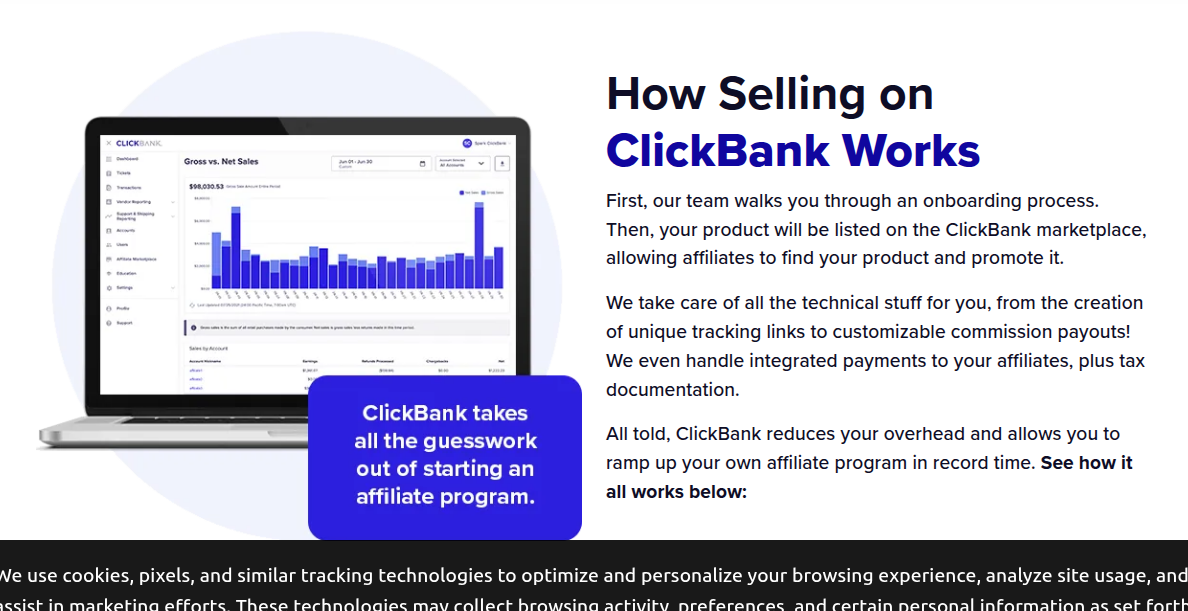
A ClickBank seller dashboard on a laptop showing a Gross vs Net Sales chart and a Sales by Account table with earnings, refunds and chargebacks, beside vendor copy saying ClickBank creates unique tracking links, handles integrated payments to affiliates, and provides tax documentation.
Merchant of record handles processing, tax and affiliate payouts. A ClickBank seller dashboard on a laptop showing a Gross vs Net Sales chart and a Sales by Account table with earnings, refunds and chargebacks, beside vendor copy saying ClickBank creates unique tracking links, handles integrated payments to affiliates, and provides tax documentation. Screenshot: clickbank.com,

What buyers keep saying

Research: unverified

Reliability and longevity ↑ frequently praised

The most consistent thing long-term users and reviewers credit ClickBank with is that it pays, and pays on schedule. It has run since 1998, and reviewers point to decades of on-time affiliate payouts across multiple payout methods as the reason the platform is treated as legitimate rather than a fly-by-night network.

“routine on-schedule affiliate payments across multiple payout methods”

ClickRaven Blog: ClickBank.com Reviews & Legitimacy in 2026

Fees and refund clawbacks eat into margin

ClickBank's cut is a real cost: 7.5% + $1 on every sale, a $5 fee on each payout, and a one-time $49.95 activation fee. Because it is the merchant of record with a buyer-friendly 60-day refund window, sellers and affiliates also see commissions clawed back when a customer returns, which reviewers note can dent earnings in refund-heavy niches.

“will occasionally see a commission clawed back after the sale”

Tekpon Blog: ClickBank Reviews 2026: Pricing & Features

Uneven marketplace quality

The affiliate marketplace is ClickBank's biggest draw and its biggest reputational liability. Reviewers describe a loose product-approval process where strong offers sit beside hyped, low-quality ones, especially in weight-loss, supplement and make-money niches, so both sellers and affiliates have to vet what they promote or list beside.

“a testament to the weak process for approving products”

BenGuOnline Blog: 7 Reasons Why You Should Avoid Clickbank

“brilliant offers sit next to hyped-up ones”

Affspace Blog: ClickBank Affiliate Program: Still Worth It in 2026?

What ClickBank costs

Free to sign up. Sellers pay a one-time $49.95 fee when their first product is approved, then ClickBank keeps 7.5% + $1 on every sale as merchant of record, plus a $5 fee on each payout. There is no monthly subscription, and affiliates join for free.

Verified against the vendor's pricing page on 2026-09-27.

Frequently asked questions

How much does ClickBank cost?
Signing up is free and affiliates pay nothing. Sellers pay a one-time $49.95 fee when their first product is approved, then ClickBank keeps 7.5% + $1 of each sale as merchant of record and charges $5 on every payout it sends you. There is no monthly subscription. Refunds and chargebacks claw the commission back out of your account, so price your offer with those in.
Is ClickBank a funnel builder?
No. ClickBank is an affiliate marketplace and merchant of record with a built-in order form that supports order bumps, one-click upsells and subscriptions. It has no page builder, no same-URL split testing and no routing across your own merchant accounts, so you host and tune your sales page in another tool and ClickBank is the single processor and retailer at checkout.
Is ClickBank legit, and will I regret it?
ClickBank is legitimate: it has run since 1998, says it has paid more than $7.3 billion in commissions on time, and pays out twice a week. You will regret it only if you signed up expecting a funnel builder. Watch two things before you list: dormant-account fees that start after 90 days with no sales, and the uneven marketplace where strong offers sit beside hyped ones.

What we read

From ClickBank

Other sources

4 discussions and reviews read for this page. Quotes are excerpts; open a link to read the original in context.

  1. [clickraven-legit] ClickBank.com Reviews & Legitimacy in 2026 Blog,
  2. [tekpon-clawback] ClickBank Reviews 2026: Pricing & Features Blog,
  3. [benguonline-approval] 7 Reasons Why You Should Avoid Clickbank Blog,
  4. [affspace-hyped] ClickBank Affiliate Program: Still Worth It in 2026? Blog,

Changelog

  • 27 September 2026 – First published. Pricing and features verified against the vendor's own pages.

Written by

Last checked 2026-09-28